
Research
Overview
While I am interested in dynamical systems of all flavors, the majority of my research has focused on the role of few-body dynamics in the production of gravitational-wave transients in dense star clusters. It’s now been over a decade since the detection of the first black hole merger and we still aren’t totally sure where these events come from. However, we can make inferences by comparing the observed population properties to the predictions of astrophysical theories.
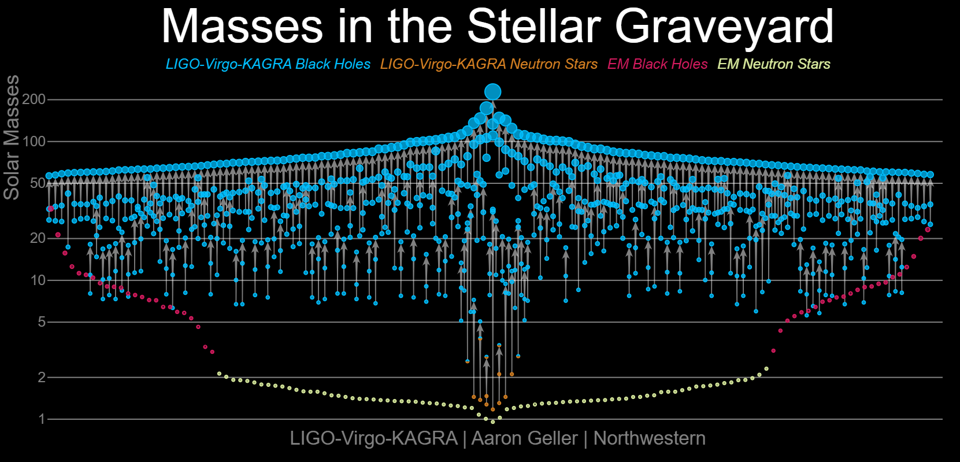
Dense star clusters are a promising environment for forming and merging binary black holes. Because the most massive objects sink to the center of the cluster, all the black holes (or their massive star progenitors) find themselves in an extremely dense environment where interactions with the other black holes are inevitable. In particular, once a black hole finds itself paired with another, the binary may undergo many few-body encounters before finally merging through the emission of gravitational radiation. These few-body encounters leave certain imprints on the population properties of merging binary black holes, as I discuss below.
Spin Tilts
A lot of information can be inferred from the distributions of spin properties of black holes. For a single black hole, we would only know its spin magnitude. In a binary, however, we have the information from both the spin magnitudes and the spin orientations with respect to the orbital angular momentum, known as the spin tilts.
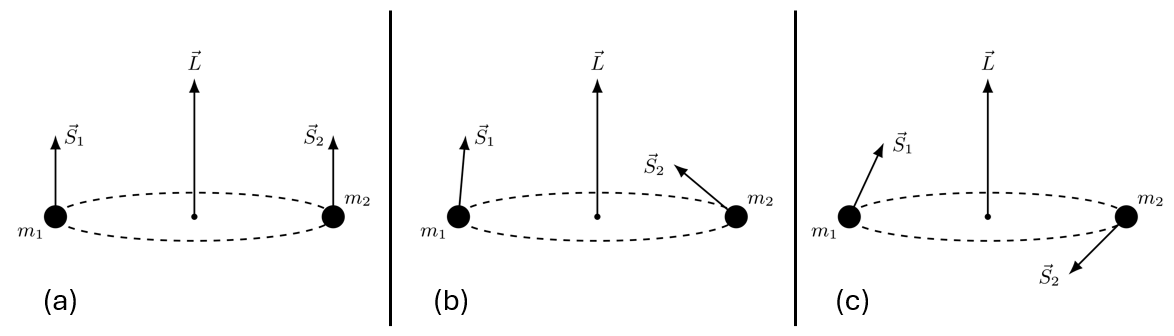
Traditionally, a cluster origin has been associated with an isotropic spin tilt distribution since the black hole are thought to be paired randomly and the different orientations would be uncorrelated. This is in contrast to binaries born from stellar evolution, which are expected to have the black hole spins aligned with the orbital angular momentum. However, in Martinez et al. (2026b), we used analytic methods and a large suite of numerical integrations to show that it can take many strong fewbody encounters for spin tilts to become isotropic. This is very interesting in conjunction with the results from O’Connor et al. (2026), where we found that, when including primordial binaries in our clusters simulations in a manner consistent with observations of star forming regions, many primordial binary black holes merge with relatively few perturbations, implying that some binary black holes can maintain their preference for aligned spins even with a cluster origin.
Intermediate-Mass Black Holes
Intermediate-mass black holes (IMBHs) occupy the range of masses between stellar-mass black holes, which can be born from the explosion of massive stars, and supermassive black holes, which sit at the centers of galaxies. A typical mass range that can be found in the literature is 102 to 105 solar masses.
IMBHs are unable to form in isolation because pair instability (the spontaneous production of electron-positron pairs) is thought to effectively cap black holes at about 40 solar masses. This is not so in cluster environments. For example, the remnants of previous black hole mergers may be retained in clusters and go on to merge again with other black holes. However, this is complicated by gravitational wave recoil kicks which, for certain combinations of spin magnitudes and orientations, can be in excess of thousands of km/s.
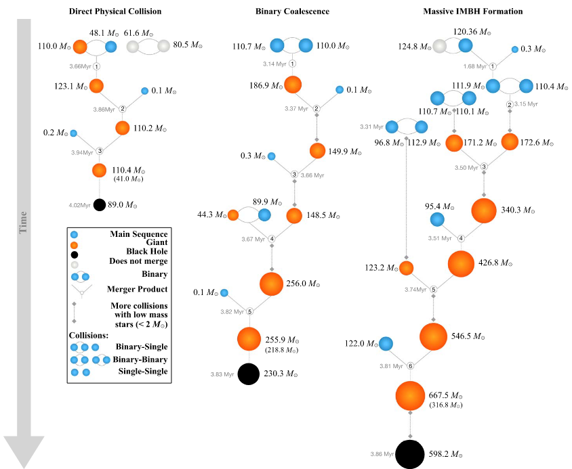
Another means of producing IMBHs is through multiple stellar collisions. In this scenario, a giant star can have a core mass below the pair instability limit but build up a large hydrogen envelope through repeated collisions with other stars. When the supernova occurs, some fraction of the hydrogen envelope may fall back onto the newly born black hole, sometimes resulting in a mass traditionally forbidden by stellar evolution (e.g., González Prieto et al. 2021). In follow-up work, we found that while an abundance of little IMBHs can be produced in Milky Way-like globular clusters, they are all ejected by either the aforementioned gravitational-wave recoil kicks or by dynamical recoil kicks following a binary–single encounter (González Prieto et al. 2022).
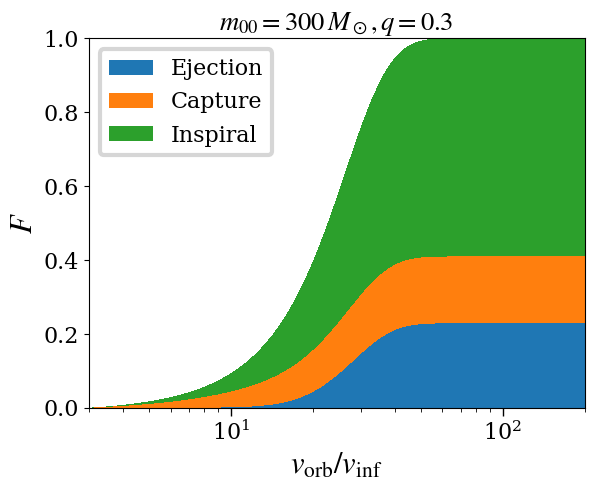
While a lot of previous studies have focused on gravitational-wave recoil, I wanted to study the dynamical recoil kicks in detail. In Martinez et al. (2026a), we combined a toy model of black hole cluster dynamics with a large suite of numerical integrations. We used statistical methods from survival analysis (specifically competing risk analysis, commonly used in fields like medicine and engineering to understand competing failure modes) to quantify the outcomes of an IMBH binary’s evolution in a star cluster. We found that IMBHs that do not grow to at least about 1000 solar masses are extremely vulnerable to ejection in realistic cluster environments.
Triple Systems
Whereas much of the above work involved the non-hierarchical three-body problem, the hierarchical three-body problem also has relevant astrophysical applications. Here, we consider an inner binary orbited by a distant tertiary companion. Under the right conditions, the tertiary can drive the inner binary to eccentricities close to unity, decreasing the time to merger. This process is known under many names, including the Kozai, Kozai-Lidov, Lidov-Kozai, von Zeipel-Lidov-Kozai, and eccentric Kozai-Lidov mechanism. These Kozai-induced mergers are especially interesting because they may retain detectable eccentricity in the LVK frequency band.
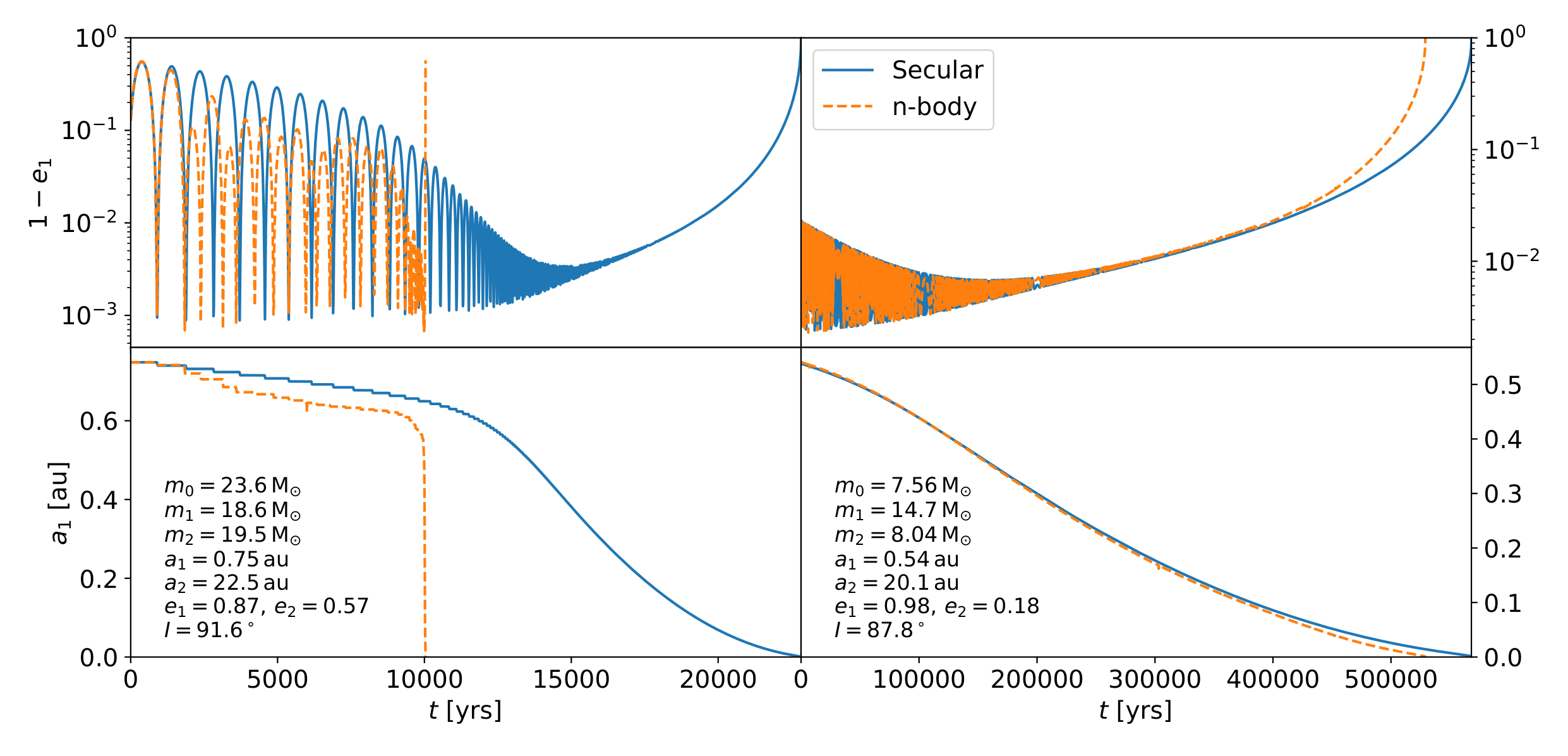
In Fragione et al. (2020), we showed that the production of triples of any composition are a natural outcome of binary–binary interactions in globular clusters. The properties of the triples imply that many of them can lead to interesting observational exotica, such as stellar mergers, X-ray binaries, cataclysmic variables, and more. In Martinez et al. (2020), we examined the subsequent dynamical evolution of black hole hierarchical triples formed from these binary–binary encounters. We showed that such triples can indeed contribute to the total black hole merger rate. Furthermore, they may constitute a small but non-negligible fraction of the total eccentric merger rate.
In Martinez et al. (2022), we compared hierarchical triples evolving in isolation to other channels, namely isolated binary evolution and clusters. We found that triple mergers can help explain the rate of asymmetric black hole mergers, where the mass ratio of the components are far from unity. This occurs because the equations of motion are sensitive to the mass ratio, such that the secular forcing is more efficient when the masses are more unequal.
Tools & Codes
- CMC-COSMIC (Developer) — A parallelized, Hénon-type Monte Carlo N-body code used to simulate the evolution of dense stellar systems.
- COSMIC-PopSynth (User) — A stellar binary population synthesis code based on SSE/BSE.
- Fewbody (User) - A tool for direct integration and hierarchy classification for fewbody (e.g., binary-single, binary-binary, triple-binary) encounters.
- Rebound(x) (User) - A generalized N-body integrator commonly used in research relevant to (exo)planets. It was a great tool for my introduction to computational astrophysics.